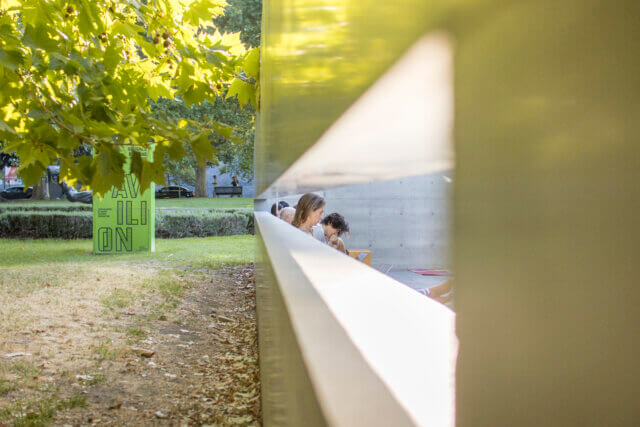
I grew up in Ngāmotu / New Plymouth. It’s a beautiful place surrounded by more beauty. The undulating volcanic plain, the ridge of the Pouākai Ranges propping up Mount Taranaki. The rivers. The bush. The surf. The snow.
But Taranaki faces some big problems. A reliance on the environmentally destructive dairy and gas industries. The lack of public transport and connections to the rest of the North Island. Expensive houses and suburban sprawl compounded by agricultural sprawl. Few meaningful jobs to keep young people in the region.
This post is the first in a series where I set out a vision for Taranaki. I offer these ideas with love and affection for the place. The mountain that speaks to my heart is Taranaki and sitting on a big rock in the middle of Te Henui alleviates my worries. I feel the call of the black sand beaches and the isolation of a drive on the Forgotten Highway.
We live in a time where we’ve seemingly forgotten our connection to the land, and indeed our connection to other people. We’ve forgotten people can come together to help reshape our country for the benefit of all the people (and maybe other organisms) who live here.
Ever since I’ve been old enough to understand politics, it’s always been about reducing the powers of the state. Tax cuts, fiscal responsibility this, blah blah free market mambo jumbo that. As someone who thinks democratic socialist anarchism is pretty cool, I kinda get wanting the state to wither away, but this right-wing neoliberal death cult is just so… sad.
We know big things can only happen when we work together to achieve them and now is the time for big radical ideas. Radical ideas that will utterly transform New Zealand and prepare us for the almost inevitable climate catastrophe. Hopefully they capture your imagination. Hopefully they provide an alternative way of thinking about, and solving, problems which our politicians and wealthy folk seem content to kick down the road.
Here’s the first one.
Rewilding Taranaki
The dairy industry, has for the last 150ish years, absolutely fucked the traditional land use of the fin of Te Ika-a-Māui. You can see this wholesale ecological devastation clear as day from a satellite image:
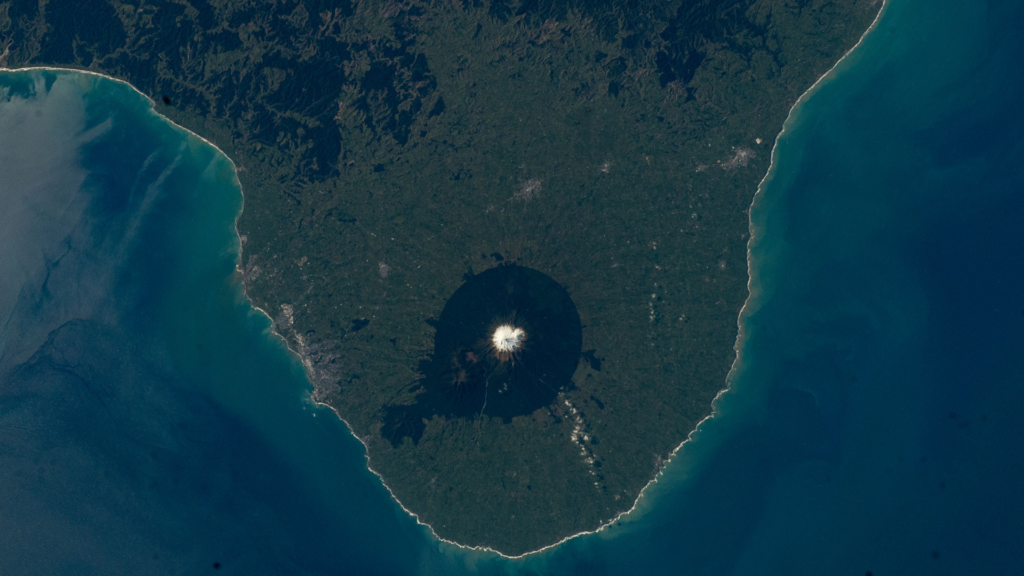
See the dark green circle around the snowy peak? That’s bush. See the light green making up the rest of the ring plain? That’s almost exclusively monoculture grassland, in fact around 50% of Taranaki’s land area is grassland, the forested stuff to the east is sparsely populated hilly privately held land (with some sheep grazing and pine forestry).
The fields of grass have cows on them. You can’t see them in the above image, but there are half a million-ish diary cows in Taranaki. Each one of those cows and each hectare of grassland is a huge wasted opportunity socially, economically, and environmentally for locals and for New Zealand as a whole.
We could be using this land much more productively to reduce New Zealand’s greenhouse gas emissions, clean up our waterways, transition away from harmful farming practices, create new industries and economic opportunities with meaningful employment.
The problem with cows and grassland
Before Māori settlement, Taranaki was almost entirely covered by bush. By the time Pākehā showed up, there had been some clearing of forests on the fertile southern plains roughly between where Ōpunake and Hāwera are now. In the last 150 years almost all of the bush has gone and what little is left keeps on going.
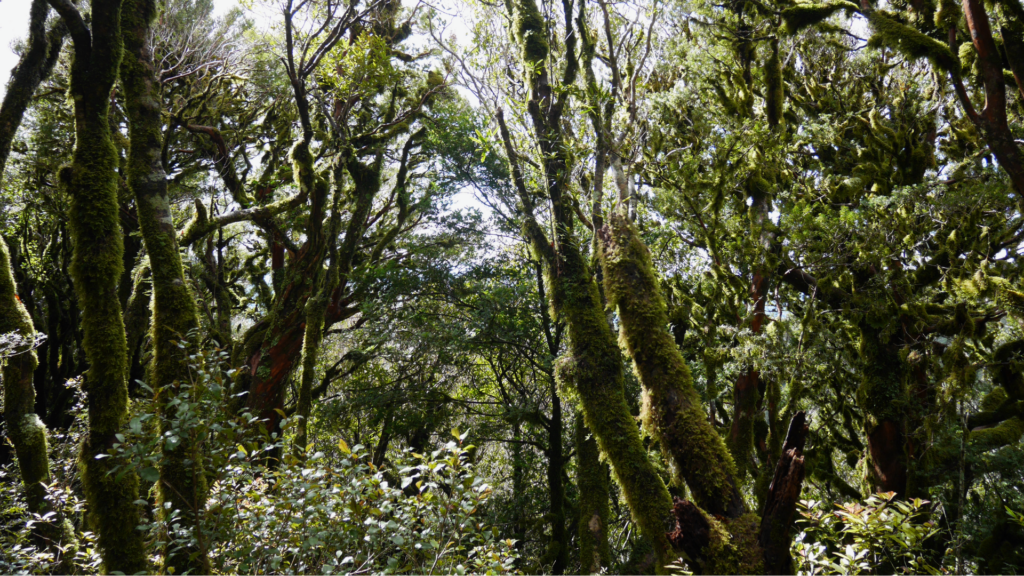
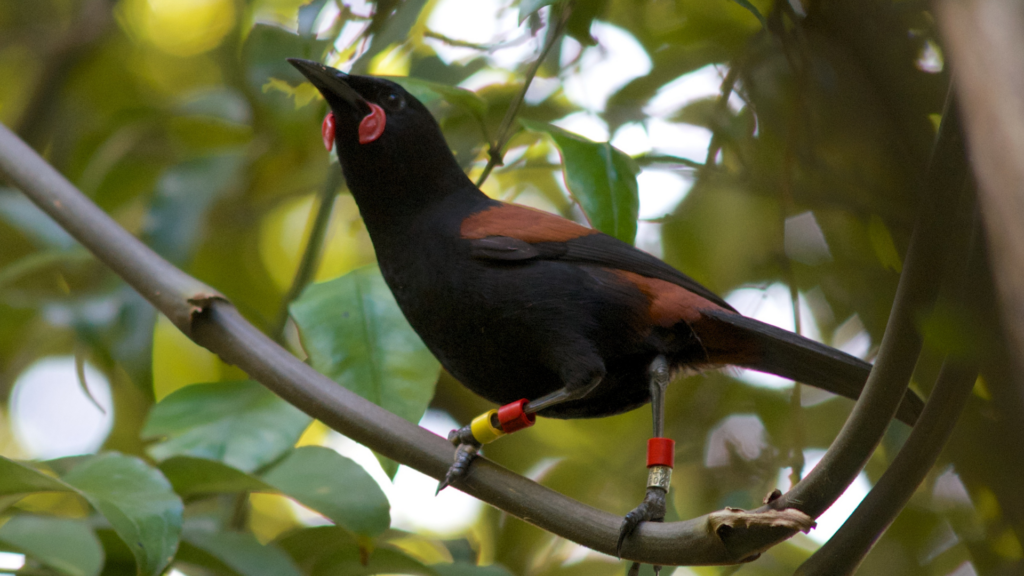
If you go for a walk in the Egmont1 National Park you’ll see a thick tangle of Rātā and Rimu, ponga, piupiu, and pirita. You’ll see Pīwakawaka flitting and hear Tūī calling and, if you’re out walking at dusk, you might even snatch a glimpse of a Kiwi. Breathe in and you’ll smell the rich organic scent of decomposition and the circle of life it helps create.
Taranaki’s soils evolved to hold dense almost temperate rainforest conditions which supported a vast array of botanic biodiversity, rich fungal and microbial communities, writhing masses of tiny critters and associated avian populations. All of this must’ve locked up a staggering amount of carbon.
After Te Tiriti o Waitangi, white fullas took this to mean they could ignore about 1000 years of Māori custodianship of the land and protection of its taonga. They started felling trees — ancient trees, important trees, any trees — to create living space for all the Pākehā folk (who had bought dubiously acquired parcels of land from an office in London and were starting to show up on boats from the literal other side of the world) and their animals.
The first cows arrived in Aotearoa in 1814, courtesy of Samuel Marsden2, but dairy as an industry didn’t really take off until refrigeration was invented in the 1880s and one of New Zealand’s first dairy factories opened in Taranaki. At one point there were 11 factories in Taranaki which started churning out milk, cream, cheese, butter, etc.
All that bush? Goooooone. Either burnt, turned into houses, or dumped.
A plague of hoofed bovines descend on Taranaki, clodding around on an ever decreasing layer of turf which was supposed to be trapped in the thick networks of roots and mycelium, not the delicate cover of clover.
I’ll let you into a little secret: cows aren’t great for the environment. They fart methane in staggering amounts. They shit copiously. The shit — and the bacteria it contains — runs into rivers. Cows demand vast quantities of grass, dried grass, and other supplementary feed. To make all the grass, farmers apply massive amounts of (fossil fuel produced) fertilisers. This runs off into rivers too, choking our waterways with algae. The shit and fertiliser means water quality is terrible. We extract the milk directly from the cow, stick it into big tanks and then cart the milk around in diesel burning trucks. We divert perfectly good plant material to feed cows which are on perfectly good fields which could be growing food us humans could be eating.
This is in a time when climate change is starting to fuck with weather patterns. Taranaki’s weather is changing with a report for the Taranaki Regional Council by NIWA concluding there will be more rain in winter and more drought in summer and more frequent extreme rainfall events. You can read the whole report here.
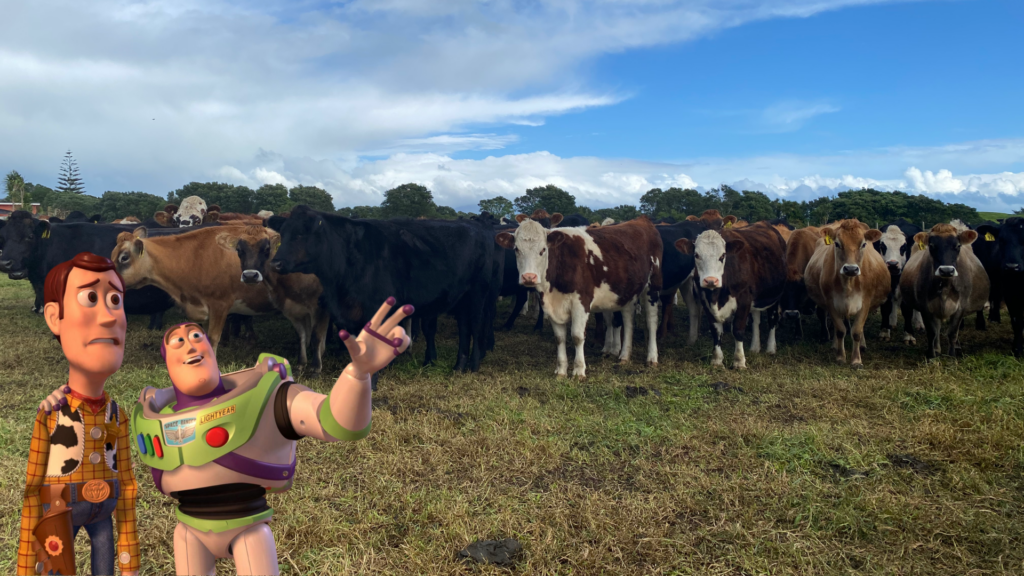
For 50% of the land area, grass is the only thing barely holding down topsoil. Lots of rain + cows hooves = muddy mess which washes away with more and more rain. Less rain + cows hooves churn up the dusty topsoil and it all blows away. In the same report from the Taranaki Regional Council, they point out biggest threat to soil is the compaction by livestock.
Fuck me. Cheese is pretty bloody delicious. But perhaps it’s time we ease up on the fromage, because it literally doesn’t stack up.
Dairy farming is just so boring.
Milking cows shows a complete lack of imagination which has just bumbled on since the late 1800s.
The industry ignores the cost to the environment and the risk of not adapting to climate change.
This farming perpetuates a shitty cycle, extracting profits from the land and workers without returning much, if anything, to the land and the people who live on it.
Taranaki can, and should, do better.
We can aspire to something more than sucking the teats of cows and drowning in their faeces until climate change makes the entire industry unprofitable and the leeches Fonterra’s corporate office, which has become bloated on full cream milk and decades of soaring diary prices, abandon Taranaki with the merest of shrugs, their parting words something like “it’s just business” just like they did when they closed and consolidated the various factories into the Whareroa factory.
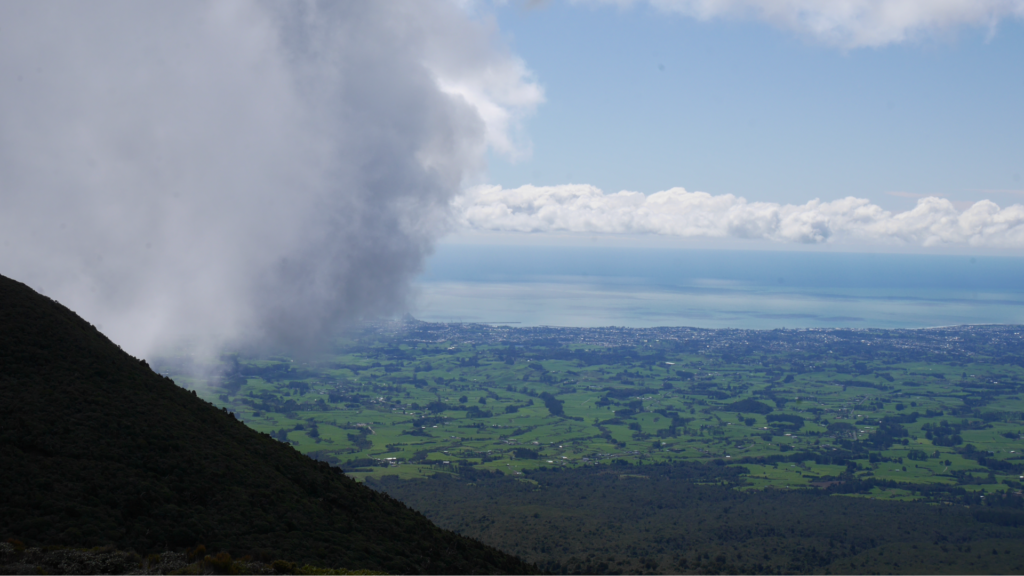
Planting a better future
So here is the plan, it’s really simple:
- We phase out dairy farming in Taranaki.
- We progressively reforest the land, working outward from the mountain.
- We retrain people into horticulture, forest management, clean energy, and other industries.
- Bonus: we build tracks and other infrastructure so people can enjoy the bush.
There are multiple ways these goals can be achieved.
We could just go out and start guerrilla planting, but can you imagine how fast the police would be out there arresting people and pulling out saplings. This approach might be a nice tactic to start the conversation, but I don’t think we’d be able to do the whole project without some more coordination.
While I’d love to think farmers would voluntarily hand the land they’re running cows on back to nature, my experience with capitalism makes me think they won’t do this without some compulsion. Feel free to prove me wrong and start rewilding, farmer folks!
But we do have this really cool tool available to us, it’s called Government.
Before, when I said we’ve forgotten people can come together to help reshape our country for the benefit of the people who live here, it feels like successive Labour-led governments have especially forgotten this while National-led governments haven’t (in the sense they have been trying to reshape the country for the benefit of rich people).
So, using this tool we have, Government can nationalise parcels of land abutting the existing National Park. Dairy farmers would be treated fairly, given time to pack down, clear out and remediate any issues their farming has caused. They would be compensated appropriately for the expropriation of the land which they occupied, but there would need to be some mechanism put in place to ensure people don’t speculate and buy up land in the hope of a windfall from the acquisition. The land would immediately become part of the National Park.
The acquisition would spiral out from the mountain, allowing time for trees to be cultivated, pest control to be done, and tracks and future tourism infrastructure to be constructed. This should happen at medium pace, I’m talking about less than two years from announcement to first planting. The aim is to have the whole of Taranaki reforested in the 2050s.
This should be done in partnership with local Iwi in a culturally and historically appropriate way ensuring that the principles of Te Tiriti are upheld. Could even, I dunno, do something really great and give the land back to the people who lived on it — just like we have recently — before it got fucked up by cows.
But what about money?
Unimaginative shills for dairy will say this is destructive, it’s too hard, or some other bullshit. I say: fuck you.
While dairy farming does employ some people, it doesn’t seem enough for how much land it uses. At a generous estimate, cow juice keeps about 4000 people in Taranaki employed. Most of the farm work is already physical labour, so retraining and reskilling this workforce is completely achievable and with the right support and levers in place, there are lots more jobs in this rewilded future.
Firstly there is the job of cultivating the trees which will be planted. Some back of the napkin maths here:
- You can easily plant around 500 trees per hectare — rows four metres apart five metres between each tree3
- There is around 335,000 hectares of grassland in Taranaki, so
- 167,500,000 trees or 42,000ish for every dairy worker.
Before cultivation starts you have all the work to prepare the damaged soil, dig the holes, plant the trees, stake them, go back and check on them until they’re established, replanting, etc.
This would also mean supercharging the Department of Conservation’s workforce, developing and nurturing hundreds of jobs in conservation, including botanists (hi dad), bird breeders (gotta repopulate dat bush with birds), water quality experts, and all the other essentially terraformers you need to try and rehabilitate grassland back to somewhere near its pre-colonisation condition. This knowledge — how to transform large patches of monoculture into thriving ecosystems — is going to be hot intellectual property in the coming decades, and we can help export that knowledge to other places looking to rewild.

While tourism is problematic in its own way and generally a low earner, we should take the opportunity to build some truly epic walking tracks and world class outdoors facilities. Imagine taking your children for a tramp along a track, staying in a purpose built cabin, and returning year after year to as it is slowly reclaimed by bush.
The biggest issue is the transition. The dairy industry itself reports almost $NZD1 billion each year is generated by milking Taranaki’s cows. I would argue at least some of the costs farmers should be paying — eg for the environmental damage they are doing — are not factored into this calculation, but again: I am not an economist.
I’m not sure exactly how to plug this billion dollar gap in the short term. As noted above, the roll out would take at least 25 years, which is a decent amount of time to start retraining, reskilling humans and converting and repurposing infrastructure and tools.
In terms of the levers Goverment can pull, there is a massive amount of work to be done to make sure dairy farmers stop externalising the cost of the environmental impact they have. Alongside better regulations, levies could be used on the dairy industry’s exports to cream off funding to offset these costs.
Government can also help leverage the knowledge of farmers and those involved with the dairy industry to build up a thriving agricultural software industry. Asia Pacific is already the largest market for use of AgSoft and is expected to grow significantly over the coming years as farmers work to better use data and automation to drive efficiencies in farming.
Other areas like green energy, irrigation technology and services, carbon capture, and other machining and heavy engineering-related industries could also be perfect for Taranaki.
Potentially we can move into sustainable forestry on sections of the land, selectively removing very limited numbers of trees, processing and storing carbon in a smart and productive way. New Zealand timbers are prized and sought after because of their beauty and strength.
The Whareroa Dairy Factory can be repurposed — which weirdly doesn’t preclude diary from being produced there, because, as I said: cheese is fucking delicious — as can Methanex. Other posts will cover other industries and ideas which can be used to transition away from dairy, as well as oil and gas, to sustain and grow jobs in the region.
One of the big problems with technological and manufacturing revolutions of the past couple of hundred years is they haven’t taken the time to reskill workers. Happy engaged people with good jobs are an important part of making sure Taranaki is liveable — environmentally and community-wise — in the coming decades.
The important thing about this transition will be creating jobs and industries which are information and service based so they can be moved. Because — and most people forget this even though they wake up and see the mountain every single day — Taranaki is literally centred around a giant big volcano which is overdue an eruption.
There’s a 30–50% change of eruption in the next 50 years. The eruption will bring pyroclastic flows, debris avalanches and lahars, and — more worryingly — large ash clouds. All this would, as natural hazard, risk and disaster researcher professor Tom Wilson of the University of Canterbury said in 2023 knock out water and electricity supplies. Presumably, the ash would cover the grassland and any cows which weren’t chargrilled by pyroclastic flows or washed away by lahars would be at risk of starvation from lack of grass. With roads and electricity likely knocked out too, what’s going to happen to the milk even if the cows survive?
A study in 2019 estimated “the net losses in economic activity from a brief Taranaki eruption was crudely estimated at between $1.7 billion and $4 billion — or between $13 billion and $26 billion over a decade of volcanism”. While a closer read of the actual paper paints a rosy picture for recovery, I just don’t see anyone — let alone central Government and insurance companies after their middling responses to the Christchurch Earthquake, the Kaikōura Earthquake, and Cyclone Gabrielle — getting prepared for something which scientists have been saying is inevitable since I was in primary school.
The environmental impact
Unsurprisingly farmers and the dairy industry are outright fighting and obfusticating policies and rules which would reduce the impact of their animals on the environment. Recently in Taranaki, farmers have been saying the quiet part out loud: they don’t give two (cow) shits about water quality, with a councillor questioning whether farms even cause pollution then trying to backpedal when questioned about it. And yes this is the same councillor who won the Fonterra Dairy Woman of the Year in 2023.
I’m not going to argue about fertiliser loads, stocking levels, nitrate concentrations, or how much E. Coli in the rivers is too much E. Coli because I’m not a farmer and all that is moo-t.
Phasing out dairy farms and planting trees means no fertiliser run off, no cows in paddocks shitting, and no nitrates in the rivers causing algal blooms. It means swimmable rivers, being able to collect kai moana without fear of food poisoning, cleaner air, it’d be the biggest expansion of New Zealand’s national parks since 1996 with Kahurangi National Park, would add another series of Great Walks to the already popular lineup, and would force Taranaki to create a more resilient local economy based on knowledge, information, and skill — not converting grass to milk via bovines.
As I have noted before, tree planting alone won’t save the planet. The science is still developing on how much carbon a tree itself can lock up, with MIT’s Climate Portal saying:
A hectare of trees … might hold around 50 tons of carbon, equivalent to around 180 tons of CO2 in the atmosphere … Studies of different forests have found that some store not much more than 10 tons of carbon per hectare, while others store well over 1,000.
There is emerging evidence, as shown in George Monbiot’s recent book Regensis and Merlin Sheldrake’s wonderful Entangled Life that if you plant forests, the soil will absorb much more carbon through fungus, bacteria and creepy crawlies than the sparse monoculture desert of grass ever will.
Complex systems are really bloody hard to tell exactly how much carbon this will lock up and, once again I’m not a climate scientist, but replacing half a million cows and the associated carbon costs with more than 160 million trees can only be a Good Thing™.
Let’s start planting
Despite what politicians would have you think, there is a growing awareness we can’t keep fucking around because we’re entering the era of finding out. A good example of a jurisdiction which has been making changes to its entire country and economy is Slovenia. Its Recovery and Resilience Plan is fantastic. Approved in 2021, the plan is “helping [Slovenia] to become more sustainable, resilient and better prepared for the challenges and opportunities of the green transition and digital transition”.
There are more than 150 projects across the country — including one to increase wood processing in an environmentally friendly way where all industries are “subject to strict do no significant harm criteria, in particular on the protection of biodiversity.”
So there are already models and best practices we can follow. At a more micro level, major international cities — like Melbourne — are taking steps to rewild where possible, even teeny tiny little pocket parks!
Rewilding Taranaki is practical, delivering a cleaner environment with real benefits for locals and New Zealand. We can work together to make big ideas like this happen and make sure we help people in the transition phase from poorly thought out dairying to a well managed economy, respectful of nature and the people living in said nature, and realistic about the long term future of the land — whether that’s due to climate change or volcanism.
The Rotokare Sanctuary shows Taranaki can, at the very least, carve out (big) chunks of land for nature and it will support the return to pre-colonisation flora and fauna. Local groups like Wild For Taranaki — and all the projects they coordinate — show people are already working toward a similar vision.
So let’s start planting.
#####
Wishing you all a happy New Year too!
Stay safe, stay sane
<3
JJW
- Fuck John Perceval, a talentless British aristocrat whose only claim to fame was being a vague acquaintance of Captain Cook. ↩︎
- A racist (who said Aboriginal folks were “the most degraded of the human race”) and sexist (who tried to register and classify all women in New South Wales) and petty (stopped a rival from publishing a Māori / English phrase book completely out of spite) man who bought the Anglican flavour of Christianity to New Zealand. ↩︎
- Of course they’d be staggered and spread out and supported with other smaller plants too, but you get the point. ↩︎