One of the things you hear most often from AI grifters is “AI will democratise [a thing]”.
It could be anything—creativity, finance, healthcare, education, or even democracy itself. Apparently, there is nothing AI cannot democratise, there’s no wrong way to use the term. But it’s hard to pin down what any AI spruiker means when they drop the “D” word. Sam Altman, the Golden God of AI, reckons AI needs to be democratic in a way that never quite makes sense. Sal Khan, of Khan Academy fame, speaks to robber baron advisors McKinsey about ‘democratising education’ but only mentions democratising once… vaguely.
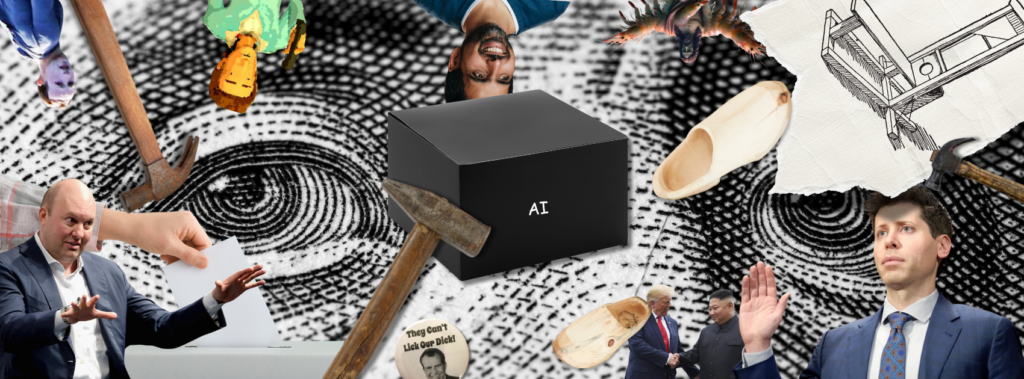
I first heard about “AI democratising democracy” in a workshop, and it ate at me, because the term “democracy” has a specific meaning. Rather than starting a fist fight in the office, I decided to talk with an actual Political Scientist. Because, spoilers, I don’t think AI is all that democratic. PR schlubs for Big Tech have just found a word they think will sell a product, that people can repeat without thinking, and that journalists will unquestioningly insert into fawning stories.
So I called Tom Jamieson, lecturer in Political Science at Te Herenga Waka–Victoria University of Wellington, New Zealand.
POLS 101
“There are a number of ‘flavors’ in terms of what democracy is,” Tom says. He identifies three well agreed attributes:
- free contested elections, with governments changing over time,
- free participation in elections and civil society, and
- a free press (not necessarily a fair one).
That’s pretty much it in Political Science terms.
Organisations that are not states/countries can also be democratic. You can elect a union rep, pass resolutions as a shareholder, or take part in New Zealand’s most cutthroat electoral contest, Bird of the Year.
But what about things that are neither nations nor collections of humans, but nouns? Things like ‘creativity’ or ‘healthcare’?
“Probably not,” Tom says. “A charitable interpretation might be they’re referring to mass participation as democracy and ‘democratisation’ as being about access to, and participation with, their tools.”
At a fundamental level Tom says it’s nonsensical to talk about a concept as being able to be democratised, and that most of the concepts AI companies are claiming to democratise are already democratic—in the sense we have democratic processes which shape them.
For example, in education, we elect a government, it chooses a Minister of Education, and the Ministry sets policies. People are free to discuss those policies or, if they don’t like the policies, use their free speech to say so. They can join a political party opposed to the policies or vote to kick the government out. On another level, we have school boards where people can affect who makes decisions and what decisions are made.
“We already have direct participation in these systems, so [democratisation in this sense] could also transfer to things like health and finance,” Tom says.
“But it’s worth questioning what’s intended [by the AI companies] and whether that’s actually something we want to do.”

Are politicians just human skinned-AI?
Politicians are like Large Language Models: they summarise vast troves of information, they’re steered by adversarial input, and they calculate the best thing for them to say to please a particular audience.
But politicians have something an LLM will never have: a brain. And while we don’t (and can’t) have transparency on how politicians think, people can judge a politician’s motives, biases, and networks.
By contrast, AI is mostly a black box. We don’t know where information comes from, how the algorithm warps it, what biases are in the code, or what strictures the coders put on the results.
Politicians are elected by people and they’re accountable to those people. They can be voted out. Algorithms—from multi-billion dollar companies backed by billionaire techno-authoritarians (especially this guy)—cannot.
This all makes it sound like AI is inherently undemocratic—or, at least, the definition of “democratic” used by Sam Altman is wildly different to everyone else’s. Given this, can AI tools enhance democracy?
Maybe?
Public consultation on a piece of law might receive tens of thousands of submissions. An LLM could process them quickly and spit out a summary. This might save time and perhaps deliver better analysis than (human) public servants.
But it comes down to the code, which is made by humans and will have flaws.
Tom is skeptical of claims AI will enhance democracy because the business model seems to be:
- privatise public domain information / data
- make money.
“You have the privilege of feeding into the models and getting an immediate benefit, but the secondary use of your information will be privatised,” Tom says.
“You can compose an email using AI but after you’ve sent it that data is stored and reused in ways you can’t necessarily anticipate. Big Tech will reap the financial benefits and it’s not going to be redistributed to the masses.”
It’s all about the data
“[The] thing that concerns me is how little people value their data and don’t think about the end use. Not just AI tools, but social media too,” Tom says.
“People don’t grasp how valuable their information is.”
Just think about how much data you feed into your phone. Sure, you get some utility out of it, but this extraction—once compiled and fed into models—means private companies can and will attempt to predict your every move.
Recent academic papers show how fucking scary this is: Facebook and Google can control what voters see and can drive voter behaviour change.
There’s a lot—especially when it comes to elections—we still don’t know and might not understand until it’s too late. OpenAI doth protest too much about the impacts AI is having and even this uncertainty might negatively impact our democracies.
Tom points out one of the papers linked above shows that by working closely with Big Tech, Trump’s 2016 campaign had a small, but statistically significant, effect on turnout in their favor.
“The issue is these tools could use material in non-transparent ways and nudge people. Given we each get different feeds in social media and results on search it’d be very, very difficult to ever know if there was any kind of interference at all. That’s a big danger.”
We know AI is being used in election campaigns. But what can we do?

Fuck with the training data
AI isn’t democratic. It’s not going to make us more democratic. AI is just another tool being used to hold your attention, suck your data, and make rich people richer.
But you know what is democratic? Democracy.
Democracy is about people working together to find ways forward. Not robots calculating. No predictions based on stolen data.
As Tom pointed out, in a democracy—even a flawed one—you still have the agency to make democracy more democratic.
Thinking about those three aspects of democracy, the next logical step is to load the training data those LLM-like politicians receive with Luddite sentiments.
Politicians hate being tied to the loss of jobs. Making the connection: AI = loss of jobs = you lose your job is a pretty compelling argument which even rudimentary political algorithms will flag. So call your local rep.
Get active in your community. Some insipid noddy (like the one at the workshop I was at) will be spruiking the ‘transformative power’ of AI. Make sure local groups know the massive risk they take in terms of privacy, data security, and reputation.
Join your union! A bottom line when renegotiating contracts should be clear policies about the use of AI and ensuring no jobs are lost from AI adoption.
The biggest thing you can do to fuck with the training data is to forge connections in the real world.
With all the major social networks and tech platforms shoehorning AI into everything, going offline and being present seems like the best tactic to combat hypercapitalism / technofeudalism / whatever it is we’re now living in. Democracy has always thrived when humans physically come together to demand something.
Given the recent elections in the US it’s even more important to keep lobbing the electric sabots into the servers, but let’s meet up too. Bring your hammers!
Big thanks to Tom for chatting to me, apologies for taking to long to get this out in the world. I first spoke to him well before the Presidential election and then I tried to get this published in a couple of places, hence the delay. Also thanks to Josh Drummond for helping me drastically edit this piece which had ballooned to +3000 words.
With the hindsight of the past couple of months and the Silicon Valley moguls removing their masks, it’s more important than ever to question whether something is actually democratic.
Stay safe, stay sane
<3
JJW