In early 2023 I had an idea.
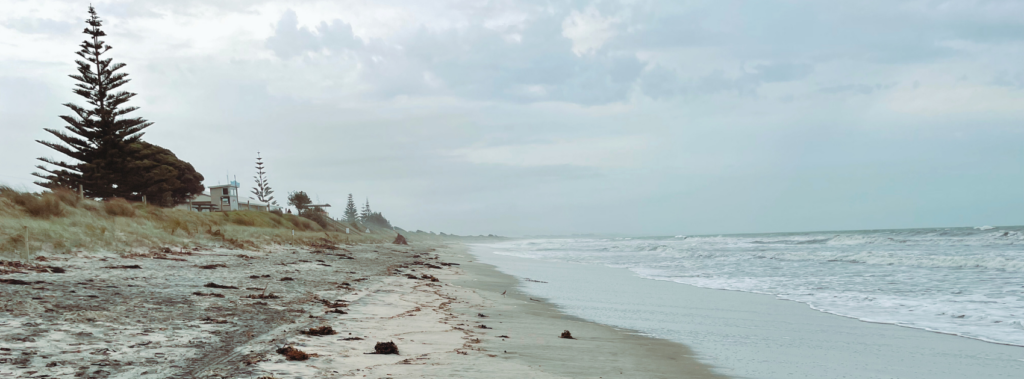
I was lying, restless at about 2:47 AM, listening to the gentle patter of rain on my tent and the muted thrum of waves on Waipu Beach. My partner and I had recently been through a traumatic life event — which I will write about, but now is not the time — and I had been reading a lot about grief and what helps get people through early stages with (some of) their sanity intact.
Writing and being engaged socially seemed to be two of the main things someone in my situation could do to help process, understand, come to terms with, and just generally augment all the other arrows in one’s mental health resilience quiver. I also like to be busy. I’m one of those people who is always doing something and has a couple of projects on the go at any given time.
As I was lying there, my mind turned to stuff I could do to look after myself. The thing I landed on was starting a writers group. I have written on/off since I was at university. First for Salient, then professionally as a communications/media/marketing/PR schlub, and sporadically for publications like RNZ, websites about sobriety, and most recently for David Farrier’s Webworm (which you should totally subscribe to). On the more fictional side, I’ve self-published a book of poetry, am an award-winning filmmaker1, and spent a few years inside the head of @DrBrash (alongside my dear friend Joshua Drummond2) a satirical Twitter account, riffing off current events and threatening to eat people’s cats.
I wanted to write. I wanted my surreal sense of humour — which leads to many self-referential personal in-jokes and unhinged chaos energy: cf. the newsletter/website you are currently reading — to help me.
Writing is easy, right?
In theory it is: put fingers on pen, apply pen to paper, words appear. But in practice there is a lot more house tidying, chore doing, staring at a blank screen, getting frustrated with yourself, overwhelming feelings of Imposter Syndrome, and sick feelings of general inadequacy in the face of the multitude of challenges one wants to write about.
About this time, Josh started a newsletter called the Cynics Guide to Self Improvement (which you should also totally subscribe to). One of his first posts was about the very predicament I was facing: “It’s just one of those days when you don’t wanna write stuff”. Which, for me, was every day in the depths of grief and depression and loss and a treacley miasma of other feels.
As I was wading through all that, Josh was being a Good Friend. Messaging me regularly and generally putting up with my inane/insane messages back. We started talking about the concept of Body Doubling, which Psychology Today describes as
Working on a task while someone else is present, either in person or virtually. This person isn’t there to do the work for you; rather, their presence acts as a subtle motivator to keep you on track3
We both read up about it and Josh wrote this piece which clearly explains the psychology, and shouts out the idea I mentioned right at the start: No Typewriters / No Talking.
But being around people, in the state I was in, was quite hard. Like, real fucking hard (and still is). It’s also weird to remember that at the start of 2023 here in Melbourne we were, bleary-eyed, emerging from two years of lockdowns, distancing, masking, limited numbers at gatherings, and fear of a virus which was still lurking.
It’s an odd feeling wanting to be social but also not trusting yourself to present in a socially acceptable manner and perhaps not trusting others around you — are they vaxxed, have they washed their hands, why are they out if they’ve got a runny nose?
So there had to be some guardrails for this body doubling, the most obvious one was No Talking.
No Talking
This rule was, and still is, there to lower the stakes of social interaction. Opening up a space where there is literally no expectation to really interact with anyone else felt like such a blissfully low-key way to readjust people to being around others in post-pandemic Melbourne.
Another aspect of No Talking is that it is egalitarian. I have been part of writing groups before and I will let you into a little secret: writers groups are (generally) fucked. Sure, you get the body doubling aspect, but you also get the brutal “constructive criticism” which is generally neither constructive or actual criticism.
The only way to get better at writing is to write.
This isn’t some Malcolm Gladwell 10,000 hours bullshit. Writing is a craft, a skill, and like learning how to be good at anything you have to spend time doing the thing you want to be good at. You will never master it, you’ll never be as good as you want to be, but you will get better. Just keep writing, as Anne Lamott says, bird by bird4.
Getting feedback from some guy — who has read a couple of Hemingway short stories and a Plath poem, who sits there twirling his pretentious little moustache (he only grew to affect a personality) while he tells you everything you did wrong in your short story, when all he’s written is an oddly oedipal rehash of the main beats of Fight Club — is not helpful. It’s harmful.
No Talking means you don’t have to share. You just come and write. When the time is up, you can leave. You never have to really engage with anyone at all. But you get that sweet sweet body doubling effect and you’ve (hopefully) written something.
No Typewriters
The origin of this rule is a little bit more esoteric. The ostensible reason for it can be found in the FAQ section, and also includes another weird guy with a moustache.
Once upon a time in a galaxy far far away, No Typewriters / No Talking founder JJW worked in a co-working space. One of the co-working space inhabitants would regularly bring in a typewriter and clack clack clack away incessantly, twirling his pompous little moustache he only grew so people would talk to him about his moustache. To say the clack clack clack weighed on JJW’s soul, tormenting him, reducing his already fragile mental health to tatters, and resulted in what the police would later refer to as an “explosive outburst” is to undersell the story.
It’s an arbitrary rule. Deal with it.
No Typewriters is about flow, concentration and respecting the space you’re in and the other folks there. Yes you can go to a cafe or the library to write, I do this often, but you’re completely at the whim of all the other patrons, the choice of radio station, or the loud chewing noises from the person at the table next to you. Ick5.
Bringing it together
Sometimes when you have ideas in the middle of the night, you cannot remember them the next day. Some of the best novels have totally been lost to smudged scribbles, a groggy brain, or want of a backpack stenographer. But, perhaps because I am extraordinarily partial to alliteration and assonance, the No Typewriters / No Talking formula really stuck.
Sidenote: To answer a question I often get asked… yes the name is, in part, homage to No Lights No Lycra. Just like the dance group, there are no limits and no judgement at our sessions. So thanks to them for grooving out a path for something like this.
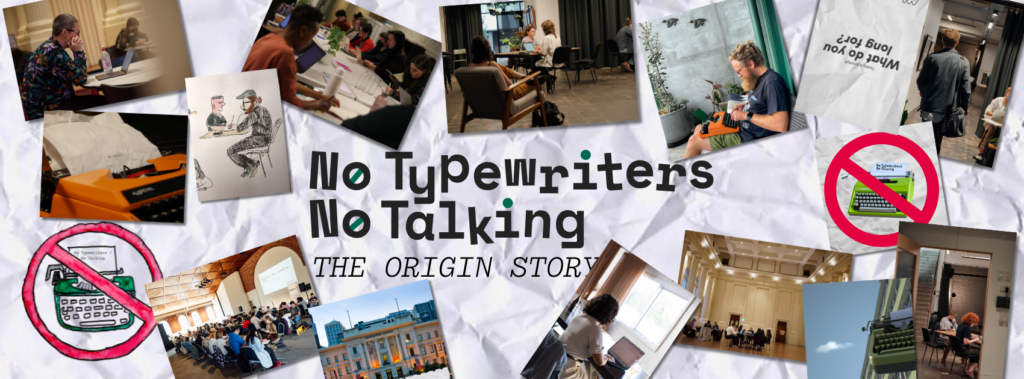
I took the idea from tent to Instagram. I did a little watercolour of the No Typewriters logo and put the idea out into the world wondering if anyone would be interested. Another dear friend, Georgina, who runs Tempo Rubato, saw the post and without even knowing it was me offered up the solemn space in Brunswick’s best piano bar.
With a venue, a vague idea of how to run events, and an email marketing tool, I started spruiking the session and the response was, much to my surprise, a little bit overwhelming in a really positive way.
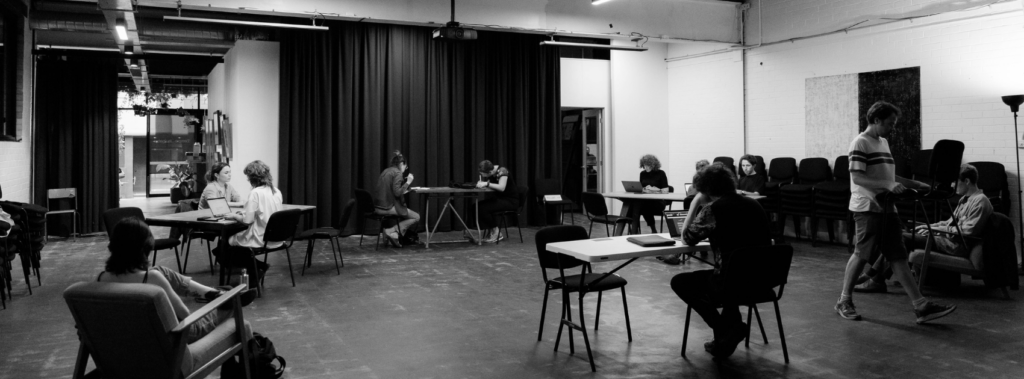
Spots for the first session on 15 March 2023 sold out, and 15 writers showed up to sit in silence and write.
Since then the group has grown and grown in a wonderfully anarchic fashion.
In 2024 we hosted 18 sessions across five venues, including an Extended Edition with three hours of writing (and a guest speaker). Across the year, more than 380 writers wrote more than half a million words and if you want to read more of me patting myself on the back and thanking all the amazing people who have helped me along the way, you can here, I could go on for days.
Why it works
Having read through all of the post-event feedback forms from the hundreds of attendees, I think I can identify a couple of key themes as to why people like No Typewriters / No Talking and, from the negative feedback, why it is a self-regulating community which eschews the normal disruption of big personalities or co-option by people who want to make it something it is not.
Making space
As a hack and a fraud consummate communications professional, one of my key messages for the group has always been that we “make a physical space so writers can make the mental space to write”. We’ve focussed on finding venues which have some other creative energy to them. Tempo is a perfect example. You wouldn’t otherwise be able to walk in there and start writing. Georgina probably wouldn’t mind, but you might set off the very loud alarm. Some of the places we’ve been, like the Immigration Museum’s Long Room, are steeped in history or 75 Reid St’s old church hall just feel warm and welcoming for community.
Single serve focus
The body doubling effect plays a part in this but also just the simple ritual of it all. Writers sit down, start writing, I tell them the time is up and then they leave (or stay for a drink). There are no distractions and no real limitations, so that mental space people create is incredibly productive: writers report they write an average of around 1100 words in an hour-long session. So not only are you being productive, hopefully getting into a state of flow, but then at the end you get a little hit of dopamine because you have achieved something, even if it is just a few short sentences.
Community without the c**ts
So we’ve made a space, people can focus in that space, and the atmosphere is welcoming and self regulating. The rules and vibe make it very hard to be cockwomble, or at least be a disruptive one. Dudes with moustaches are welcome just as long as they follow the rules.
Another another dear friend, and No Typewriters regular, Matt H had this to say:
Often in writing or other creative groups — and life in general — you find people join in order to hold other people hostage to their bad opinions and attempts at charisma. But the fact No Typewriters / No Talking explicitly forbids talking for the duration, means these people can’t find any satisfaction in the activity, and therefore seem to self-exclude after their first experience, sparing everyone.
One thing I always find amusing (and this is no shade to the extroverts, love you) is when a Big Personality shows up. It is wonderful to watch them squirm with the realisation there is no way for them to assert dominance.
What is even more wonderful is to see the people who turn up, sit down, write, and then leave — the ones whose name I only know because I have to check them in — they get it.
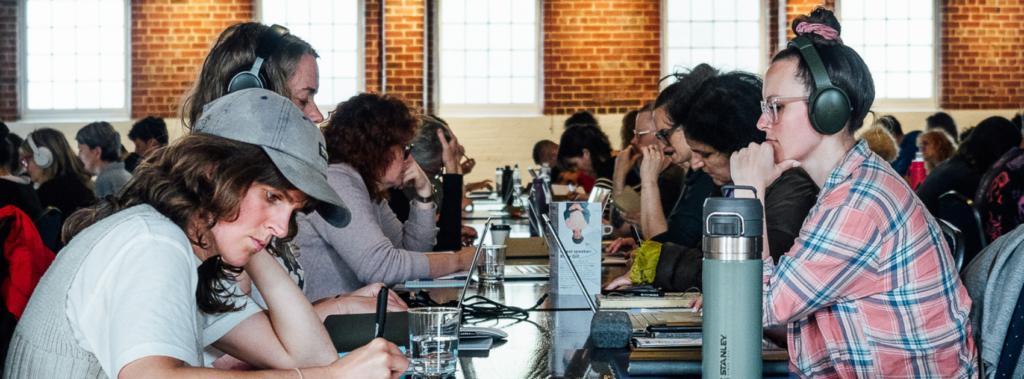
Which is partially why in the almost two years of running these events, I’ve only ever had to tell one person to shush and zero people have tried to sneak a typewriter in. All this is to say that the community of people come to the sessions because they are productive, and they keep coming because it’s very hard to have a falling out with someone who doesn’t speak.
There are only two rules
People generally leave negative feedback because it didn’t meet their expectations or they wanted something more. And look, not every session has been perfect and I am a mere man who has managed to selfishly trick people into paying to come sit in a room with him to write find spaces for people to come write in.
But when feedback is warranted I do take it onboard. I’ve changed a bunch of things based on the suggestions. In saying that, I am very aware some people will never be happy. I’d like to think the concept is pretty darn clear, the rules are literally in the name, how a session works is described clearly on the Humanitix page when people buy a ticket, and there are the FAQs.
But here’s the thing: those people who complain generally don’t come back and I’m okay with that because there is a core group of people who do come back. In fact, the data tells me a third of people who have ever come to a session have come to at least two sessions. There are a handful of people who are in double digits and two people who have come to almost every session!
Where to next?
With the sessions just kinda kicking along with a nice rhythm, I am looking to host more sessions in more places more often. To prove I do action feedback: the top demand in 2024 was for us to host sessions in Collingwood. You asked and I delivered with the help of the wonderful folks at Molly Rose Brewing, who have offered us their space to come write. We hosted our first session there last week, it was beautiful and had a very different energy to the other places we’ve run sessions. We will hopefully have more Molly Rose sessions coming in the new year and next week we’ll be announcing a new venue for Sunday mornings. Stay tuned.
The other constant demand from attendees is they wanted a pathway to being published. This was something I was initially reluctant to offer as it seemed quite ambitious to, straight out the gate, be all like “hey guiz come to a thing and get published”. It seemed almost, dare I say, grifty. But with so many writers coming to sessions, I think putting something together will a) be relatively easy and b) be quite rewarding and fun, a nice way to give a physical artefact back to people who have taken the time to come write a thing. Submissions for Patter will open early 2025, and we’ll select 10 pieces from writers who have attended at least one session.
I can honestly say running this thing, bringing people together, making new friends, and helping writers write is incredibly rewarding and has had the desired effect of keeping me vaguely sane the last two years. I am still a bit bamboozled when people show up, keep showing up, and say nice things about No Typewriters. But if people keep showing up, I’ll keep on running ‘em.
A big thank you to everyone who has (knowingly or unknowingly) supported me with this weird tent idea. I’m still struggling through this grief/loss/trauma situation, but having something to do and keep busy and that helps me write and be social has probably, in at least a small way, saved my life. Thank you, and see you at the next session.
Stay safe, stay sane
<3
JJW
- Sort of. In 2015, Daniel, Jasmine, and I won the ‘Incredibly Strange Film’ award at the 2015 Wellington 48 Hour Film Festival for our film Previously On… which played on the silver screen at the freakin’ Embassy Theatre! ↩︎
- It was very very crowded up in there. ↩︎
- Psychology Today. (2024). Harnessing Focus with ‘Body Doubling’: A Strategy for ADHD. [online] Available at this link [Accessed 14 Dec. 2024]. ↩︎
- This is why this AI slop irks me so much. ↩︎
- If anyone has any tips for dealing with misophonia please let me know 🫠 ↩︎